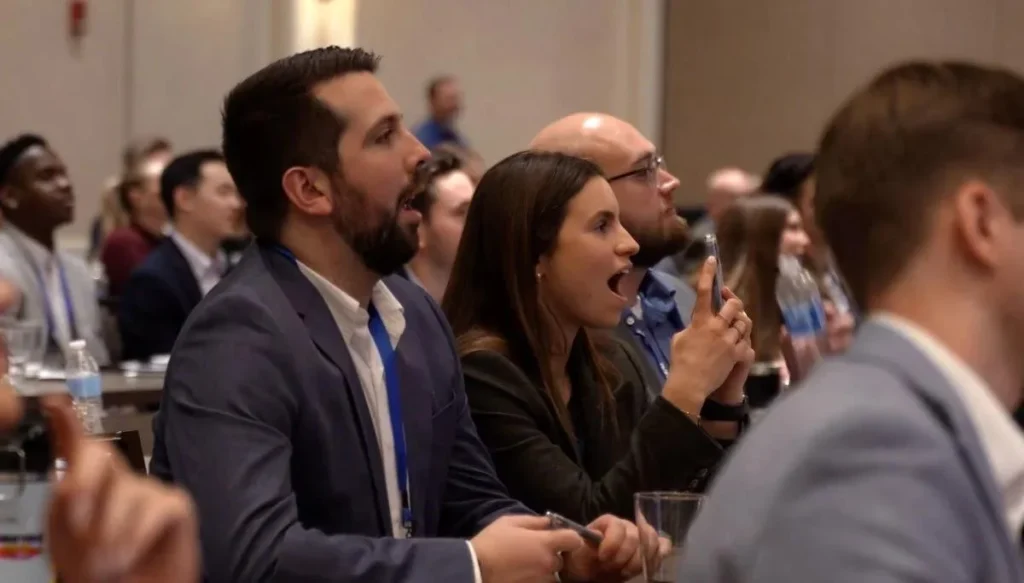
Most sales kickoffs are planned by people who are also trying to close the year. In a Gartner Peer Community survey of 92 sales professionals, the most-cited challenge in planning an in-person SKO was being too busy with the Q4 close. So the hotel gets booked over the summer, the agenda comes together in pieces, the awards list waits on final numbers, and entertainment ends up as a line somebody fills in December, if anybody fills it at all.
That is a strange way to treat one of the most expensive rooms your sales org fills all year. J.Shay Event Solutions puts in-person kickoffs at roughly $1,000 to $4,000 per attendee, and most of that pays for logistics: flights, hotel nights, meals, AV. Very little goes to what happens to the room once everyone is in it.
I have spent 25 years performing mentalism and close-up magic, including for corporate clients like Siemens Healthineers, Varian Medical and Johnstone Supply. This is a guide to sales kickoff entertainment from the performer’s side of the stage: which slots on an SKO agenda it improves, which ones it wrecks, and how to schedule it so it protects your training time instead of competing with it.
Sales Kickoff Entertainment Guide: What’s Inside
What a kickoff is for, and the two jobs entertainment can do
Forrester boils a sales leader’s job at kickoff down to four things: celebrate the wins, communicate performance expectations, educate client-facing teams, and motivate everyone for the year ahead.
Entertainment can’t do two of those. No performer is going to explain your new comp plan or teach the product your reps have to sell in February. But the other two, celebrate and motivate, are exactly what live entertainment is built for. Scheduled well, it even helps with the communicating and educating, because the room walking into your training sessions is awake, mixed up and paying attention.
Reps are clear about why they come. When Opus Agency surveyed tech sales professionals, product demonstrations and skills training came out on top, and awards and recognition didn’t make the top of the list. That is a healthy instinct, and it is the first rule of SKO entertainment: it should never cost your reps training time. It belongs in the hours around the training (arrival night, transitions, dinner), not in the middle of it.
The other thing reps are clear about: they want the kickoff to be less passive. In a Brainshark survey of 107 reps, managers and sales leaders, 74% said their company’s kickoff didn’t deserve an A, and 61% said they wanted it to be more interactive. That survey dates to 2018. Ask anyone who has sat through a third straight afternoon of slides whether the complaint has aged.
A room full of people who persuade for a living
Sales teams are a great audience for mentalism, and a demanding one.
Salespeople read people for a living. They know what a leading question sounds like, they notice when someone is steering a conversation, and most of them are competitive enough to spend the entire performance trying to work out how it’s done. Skeptics make my favorite volunteers, and a room full of reps is a room full of professional skeptics.
That is why mentalism fits a kickoff better than you might expect. It isn’t about a card or a coin. It’s built from the same raw material your reps work with every day (psychology, observation, suggestion and timing), and the moment it produces is one they recognize: a person makes a choice in their own head, and someone who couldn’t possibly know it says it out loud. If you’re new to mentalism, here’s what a mentalist actually does, and why it isn’t a psychic act.
One caveat: a mentalism set is not sales training, and I won’t pretend it is. If you need a methodology facilitator, hire one. My job is to make the room want to be there when the facilitator walks on. For more on why this works so well with professional audiences, see why corporate mentalism is the secret weapon for company events.
Four slots on an SKO agenda, and what entertainment does to each
Most kickoffs share the same skeleton: people fly or drive in, there’s a welcome reception, a day or two of general sessions and breakouts, an awards dinner, and a closing session on the last day. Entertainment does something very different in each of those slots.
1. The arrival-night welcome reception: the best slot on the agenda
Arrival night has three problems built into it. People show up in waves as flights land, and in a Chicago January, some of those flights are going to be late. Regional teams find each other and stand in a tight circle all night. And your new hires, who may be meeting most of the company in person for the first time, have nobody to talk to. That last one matters more than it looks. In the same Gartner survey, onboarding new hires was one of the three most important elements of a kickoff, alongside recognizing high performance and account planning.
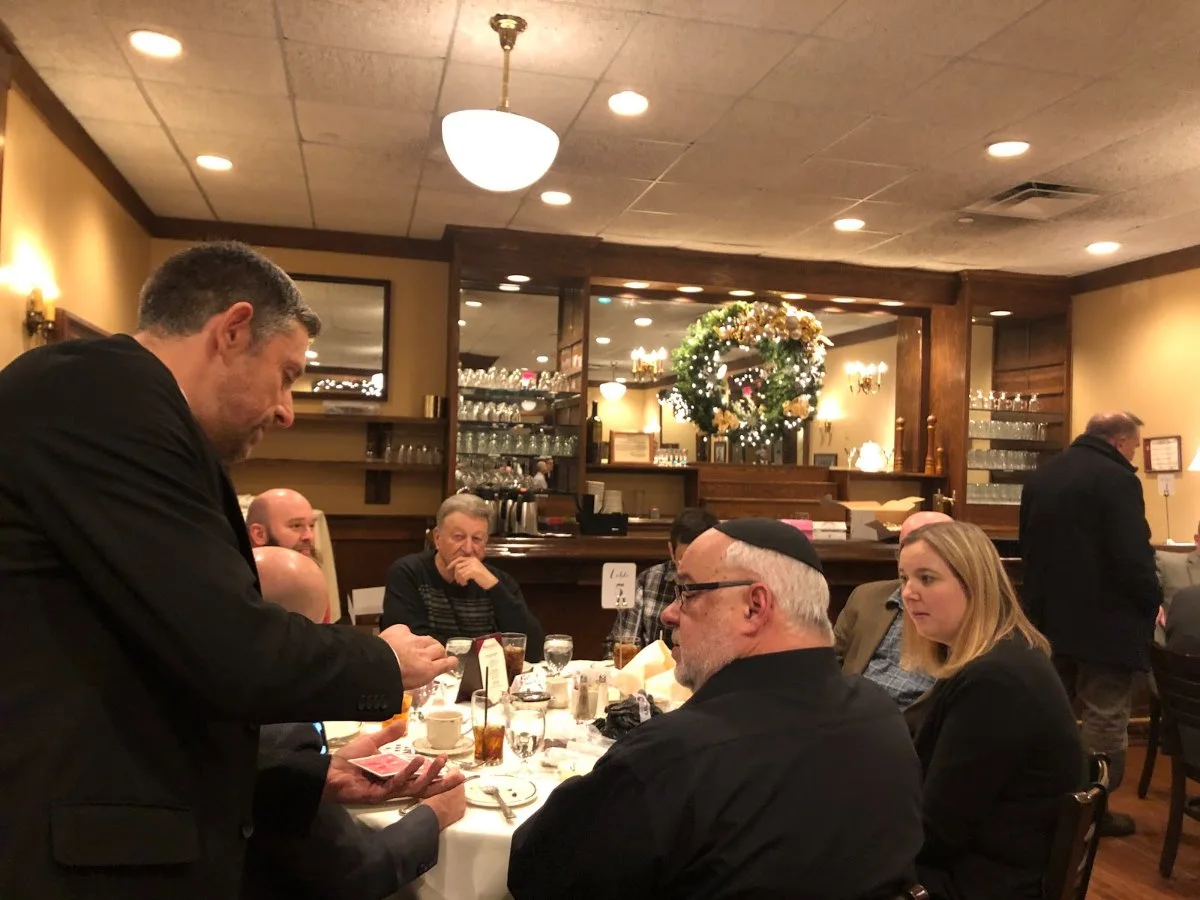
Strolling mentalism solves all three. I work small groups of three to eight guests, perform a piece built for that circle, and move on. Clusters open up, the new hire standing at the edge gets pulled into the middle of something, and whoever just walked in from the airport can join the next group without having missed anything. Because it needs no stage, no sound system and no setup, it works in whatever pre-function space or hospitality suite the hotel gives you.
For planning, I figure on about 40 to 50 guests per hour so every group gets real time. A 100-person reception is a comfortable two hours. For 200 or more, you either extend the window or pair the reception with a feature set later in the kickoff.
2. The opening general session: a strong slot, if you keep it short
The first session sets the temperature for the whole kickoff. A short set of around 25 minutes, right before your CRO takes the stage, means leadership walks out to a room that’s already leaning forward instead of one that’s still finishing its coffee and answering email.
Two rules make this work. Keep it short: the opener is there to serve the keynote, not compete with it. And talk to your AV team ahead of time about the microphone and the handoff to the next speaker, so there’s no dead air between the last laugh and the first slide.
3. The awards dinner or President’s Club night: where recognition lands, or doesn’t
Recognizing high performance was also on Gartner’s short list, and it’s the part of a kickoff most likely to go flat. A long list of names, a room that has been in sessions since 8 a.m., and half the audience quietly checking their phones while someone else’s team gets called up.
This is where I’d put a feature set. Strolling during cocktails and between courses gets the room mixing again. Then, once plates are cleared (I want everyone finished eating before a stand-up show begins), a 35- to 50-minute set brings the whole room together right before the awards. Volunteers come from your own team, and with a pre-event call we can work in your people, your year and your inside jokes. By the time the first name is called, the recognition is landing in a room that’s warm and paying attention, not one that’s waiting for dessert.

After the awards, hand the night to the bar or the DJ. If recognition is a big part of your culture beyond kickoff, I also build employee appreciation programs around the same idea.
4. The closing session: usually the wrong slot
The instinct is to end big. The problem is that by the last afternoon your reps are watching the clock and their flight apps, and attendance thins as people slip out for the airport. A closing act plays to whoever stayed, which is rarely the audience you most wanted to reach. If you want a big finish, move it to the last night’s dinner, while everyone is still in the building.
Other sales kickoff entertainment ideas, judged by what they do to the agenda
Here’s the rest of the usual list: what each option does well, and what it costs you elsewhere in the kickoff.
Motivational keynote
Does well: delivers a message, adds outside credibility, can reframe the year.
Costs you: budget (J.Shay puts outside keynotes at $10,000 to $75,000), and it’s one more person talking at a room that has been talked at all day. Pick for fit, not fame.
Team-building challenges and games
Does well: interactive by design, mixes regions and roles, answers the “less passive” complaint directly.
Costs you: agenda time, often an hour or more, and not every rep loves being told to have fun. Works best with a clear winner and a hard stop.
Stand-up comedian
Does well: big laughs, and it can be terrific on an awards night.
Costs you: tonal risk. Material that roasts leadership or leans edgy in front of HR and a row of new hires can go wrong fast. Vet the set in detail.
DJ, band or party
Does well: the right way to end the last night.
Costs you: volume. On arrival night, when the whole point is getting people to talk to each other, loud music works against you.
Casino night
Does well: competitive, fun, very on-brand for a sales team.
Costs you: it pins people to a table with whoever sat down first, which usually means the people they already know. Better as an after-party than as the mixer.
Strolling mentalism or close-up magic
Does well: mixing, arrival nights, late arrivals, pre-function spaces with no stage.
Costs you: it isn’t a spectacle, and coverage has limits. Bigger rooms need more time or a stand-up set.
Stand-up mentalism set
Does well: one shared moment for the whole room, with volunteers from your own team.
Costs you: 25 to 50 minutes of agenda, a seated and fed audience, and a microphone for larger rooms.
Notice the pattern. The options that help most early in a kickoff are the ones that get people talking to each other. The ones that help most at the end are the ones that let them cut loose. A lot of kickoffs get this backwards: a loud party on arrival night, and nothing but a hotel bar after the awards. If you want the mechanics of the two formats in more detail, I’ve written about strolling versus stand-up shows.
A sample SKO run of show
Here’s how that fits together for a typical two-day kickoff. Adjust the clock times to your own agenda. The principle is what matters: entertainment brackets the training and never replaces it.
Sales kickoff · Chicagoland
The SKO Run of Show That Protects the Training
A two-day structure built on one rule: entertainment goes in the hours around your sessions, never in the middle of them.
| Arrival night | |
| 6:00 PM | Welcome reception opens Strolling mentalism starts right away, not after everyone has landed. Late flights join midstream. |
| 8:00 PM | Reception wraps Regional dinners or a free night. Nobody sits through a program after a travel day. |
| Day one | |
| 8:30 AM | Opening general session A 25-minute opener, then the CRO keynote in a room that’s already awake. |
| 10:00 AM | Strategy, product and skills sessions Protected time. No entertainment until the last session ends. |
| Awards night | |
| 6:00 PM | Awards reception Strolling during cocktails, mixing regions and roles before anyone sits down. |
| 7:00 PM | Dinner Keep the speeches short while people eat. |
| 8:15 PM | Feature mentalism set Plates cleared, the whole room together, volunteers from your own team. |
| 9:05 PM | Awards & President’s Club recognition The warmest, most attentive minutes of the kickoff. Everything earlier in the evening is there to set them up. |
| 9:45 PM | DJ, bar, celebration Now it’s a party. |
| Day two | |
| 8:30 AM | Account planning and breakouts The sessions that turn a kickoff into pipeline. |
| 12:00 PM | Closing remarks, lunch, airport No closing act. Your reps are already checking their flights. |
How to think about the cost
Start with the whole budget, because that’s the number your finance team is looking at. J.Shay’s ranges put a national, two-to-three-day hotel kickoff at $1,800 to $3,000 per attendee. For 150 reps, that’s $270,000 to $450,000 before anyone says a word from the stage. Treat those as one event producer’s ranges rather than audited data. Either way, most of an SKO budget is the cost of getting everyone into one building.
Seen against that, entertainment for an arrival night and an awards dinner is one of the smallest lines on the sheet, and one of the few built entirely around how the room feels once everyone is there. I quote corporate work by hours on site, group size and format. I keep general pricing guidance on the site, and the FAQ covers how booking works.
Be clear about what you’re buying, too. I can’t promise that a mentalist moves quota attainment, and you should be skeptical of anyone who says they can. What you can measure is how many people show up to the optional arrival-night reception, how the evening events score on your post-event survey, and the least scientific but most telling metric of all: whether people are still talking about the first night at breakfast.
Booking timeline for a January or February kickoff
Kickoffs cluster at the start of the calendar or fiscal year, which means the same few weeks in January and February get booked by everybody at once. The Offsite blog’s Q1 2027 planning guide lays out the lead times that matter:
- Venues: rooms that hold 100-plus people, with breakouts and AV that works, book four to six months out for peak season.
- Speakers and facilitators: the good ones book a full quarter ahead, and the biggest names up to a year.
- Flights: lock January travel by November, before holiday pricing eats the budget.
- AV, catering and transportation: give those contracts at least 60 days.
Entertainment usually has a shorter lead time. For most corporate events, four to eight weeks’ notice is enough for a weekday date, and six to ten weeks for a weekend. Kickoff season is the exception: everybody wants the same few weeks in January and February, so treat entertainment like a speaker and lock it in before the holidays. From there:
- When you book speakers: entertainment contracted and slots chosen.
- Six to eight weeks out: run of show drafted with real clock times, including when entertainment starts and, just as important, when it stops.
- Once the agenda and awards list are final: a pre-event call to tailor the performance. Your theme, your people, anything you want worked in or kept out.
- Week of: confirm the microphone, the stage time and who hands off to whom.
If your company also throws a December holiday party, the same logic applies there. I’ve written a separate timing guide for company parties.
Venue notes: Rosemont, Schaumburg, Oak Brook, Naperville and downtown
Where your kickoff happens changes what the entertainment needs to do.
Rosemont and the O’Hare hotels. If your team is flying in from around the country, the hotel district around O’Hare, from the Hyatt Regency O’Hare to its neighbors, is the obvious choice. It also means arrival night stretches across the whole evening as flights land, and January weather tends to delay somebody. That is exactly the reception strolling mentalism is built for. More on Rosemont events.
Schaumburg. The Renaissance Schaumburg Convention Center Hotel connects directly to the Schaumburg Convention Center, which puts a large general-session room and plenty of breakouts under one roof. Big rooms like that are where a stand-up set earns its place, because it’s one of the few things on the agenda that gets 300 people reacting at the same moment. More on Schaumburg events.
Oak Brook and Naperville. Regional teams that drive in often land at conference hotels along I-88. At a smaller property, the same ballroom may flip from general session to awards dinner. Plan for the reset: while staff turn the room, a reception in the pre-function space with strolling entertainment keeps everyone together instead of scattering to their rooms. More on Oak Brook and Naperville events.
Downtown Chicago. Your competition on night one is every restaurant within walking distance. If the welcome reception isn’t worth staying for, your reps scatter into small groups, usually made up of the people who already know each other. Give them a reason to stay. More on Chicago corporate events.
Six questions to ask any SKO entertainer before you sign
- “What’s the shortest version of your set?” Kickoff agendas always get squeezed. The right answer compresses and still lands the finish.
- “Can you work a reception where people arrive in waves?” Anyone who needs the whole room in place at once is the wrong fit for arrival night.
- “How do you choose volunteers?” You want a mix of regions, roles and seniority, and nobody embarrassed in front of their boss.
- “Can you work in our theme or our people?” A pre-event conversation about your year, your winners and your inside jokes is the difference between a generic act and your kickoff.
- “What do you need from our AV team?” For strolling, nothing. For a stand-up set, a microphone and a clean handoff.
- “Is your material clean for a mixed corporate room?” Executives, new hires and HR will all be in the same ballroom. The only acceptable answer is yes.
There’s more on vetting performers in my hiring guide.
If your sales team also works trade shows, see these trade show entertainment ideas that pull traffic to your booth.
Frequently asked questions
What is the best entertainment for a sales kickoff?
It depends on the slot. For arrival night, pick something that gets people mixing, like strolling mentalism. For the awards dinner, a feature set that brings the whole room together before the recognition. For the last night, a DJ or a band. The mistake is booking one act for “the kickoff” without deciding which part of it you’re solving for.
How long should sales kickoff entertainment be?
A general-session opener runs about 25 minutes. A feature set at the awards dinner runs 35 to 50 minutes. Strolling at a reception depends on headcount: I plan on 40 to 50 guests per hour, so a 100-person reception is about two hours.
Is mentalism appropriate with executives and new hires in the same room?
Yes. The material is clean, and what I reveal are the words, names and choices guests make during the performance, never private details about their lives. Or their numbers.
Can the performance be tailored to our kickoff?
Yes. Every corporate booking includes a pre-event consultation, volunteers come from your own team, and inside jokes and shared history can be woven into the show.
Do you perform at hotels near O’Hare and in Schaumburg?
Yes. I perform across Chicago and the suburbs, including Rosemont, Schaumburg, Oak Brook, Naperville and downtown.
How far ahead should we book for a January kickoff?
For a typical weekday corporate event, four to eight weeks is enough. January kickoff dates are more competitive, so book when you book your speakers, ideally before the holidays. Later is sometimes possible, but popular January and February dates go first.
The short version
Book entertainment for a slot, not for “the kickoff.” Put strolling on arrival night, when people are landing in waves and new hires need a way in. Put a feature set before the awards so the recognition lands in a warm room. Keep your training hours protected. And don’t schedule anything for the last afternoon.
If you’re planning a sales kickoff in Rosemont, Schaumburg, Oak Brook, Naperville or downtown Chicago and want a second opinion on where entertainment fits in your agenda, including whether it fits at all, get in touch or call 847-773-5306. Send me your draft agenda and I’ll tell you which slot I’d use.
More on formats and event types: corporate event entertainment · employee appreciation programs · about Nick