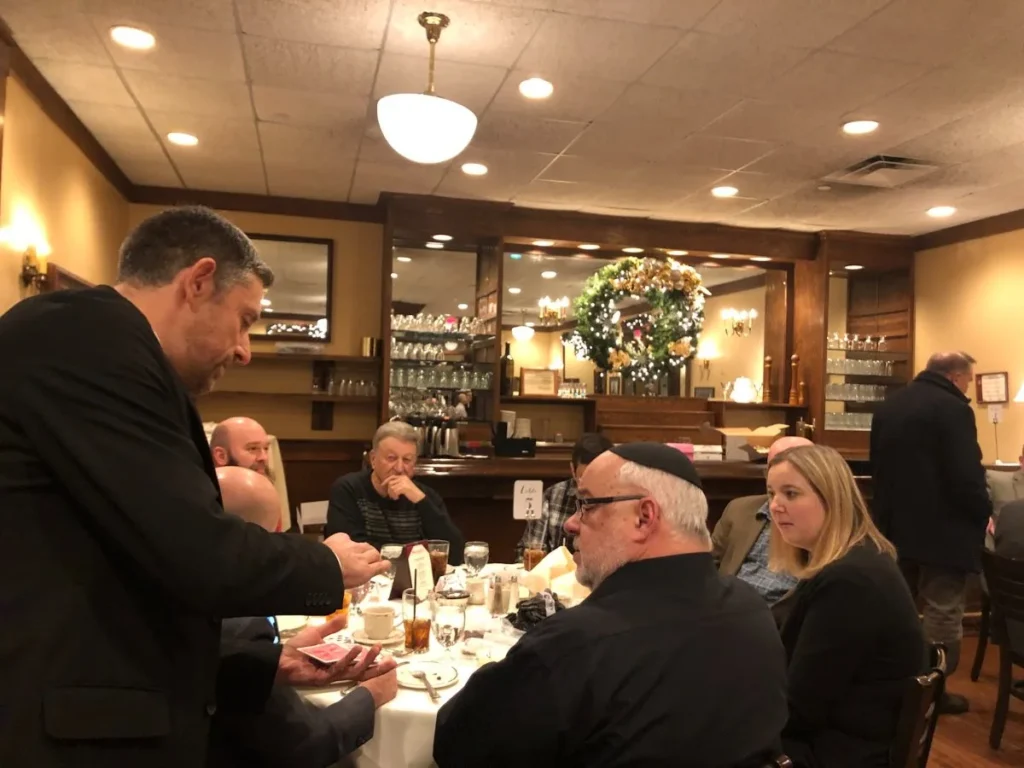
By December, most of your team has been to three other parties. They know the room, they know the buffet line, and they know roughly when they can leave without anyone noticing. The venue is rarely the problem, and neither is the food. What separates a company holiday party people talk about in January from one they forget by the following Monday is whether anything actually happened in the room.
This is a practical guide to corporate holiday party entertainment for companies across Schaumburg, Rosemont, and Elmhurst: the formats that work, how to match one to the room you have booked, and what each of these three very different markets tends to need.
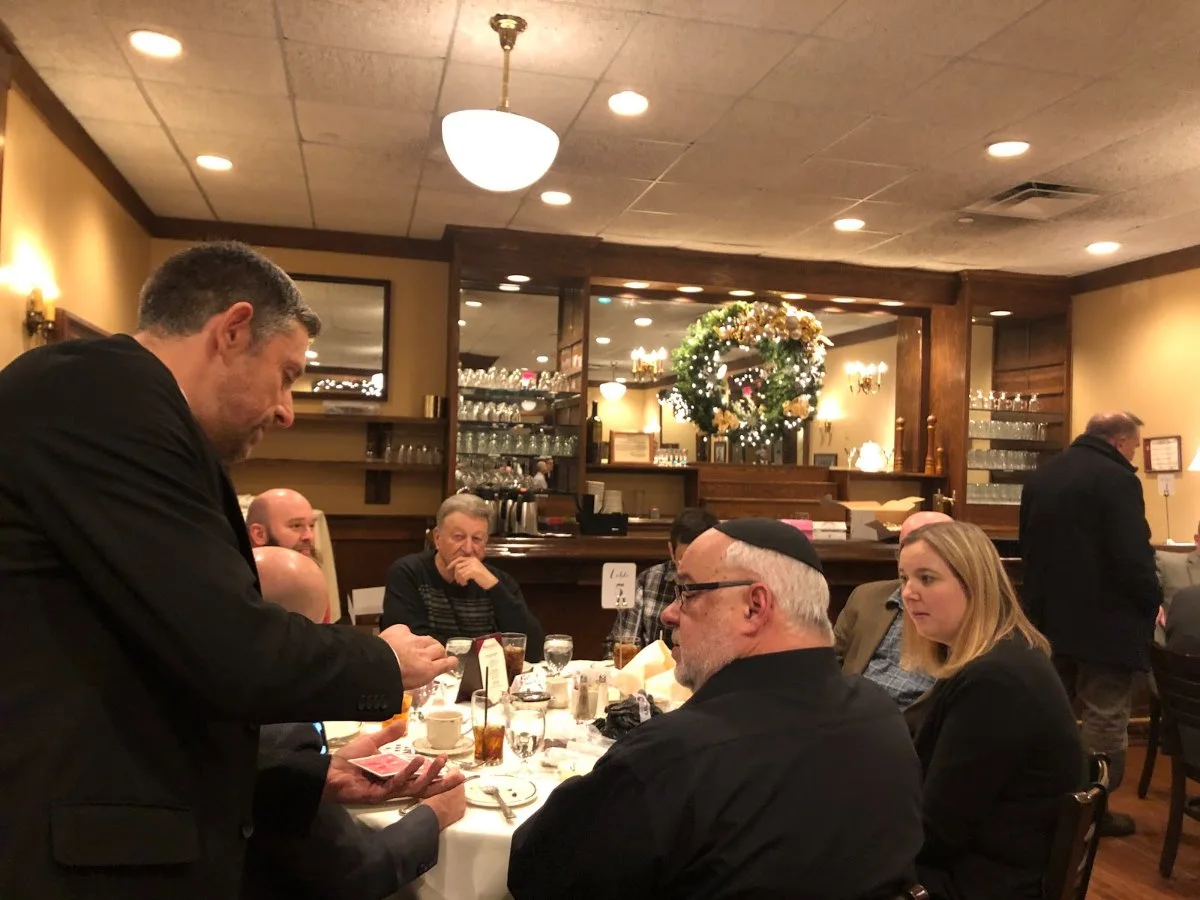
Close-up magic during the cocktail hour turns a stiff first hour into a room that is already talking.
Holiday Party Entertainment Guide: What’s Inside
Why the dinner and a playlist holiday party stopped landing
The standard company holiday party has not changed much in twenty years. There is a cocktail hour where people cluster with the coworkers they already talk to every day, a dinner, a few remarks from leadership, and background music nobody is really listening to. It is pleasant. It is also completely interchangeable with every other holiday party happening that week.
The structural problem is that nothing in that evening requires anyone to pay attention at the same time. Departments stay in their own corners, the new hires stand near the bar, and the shared experience the party was supposed to create never quite forms. A DJ fills silence, but silence was not the issue.
Live entertainment that involves your guests directly solves a different problem than music does. When a group watches something genuinely surprising happen to someone they work with, they react together, and that reaction is the thing they carry back to the office. It is also the reason close-up magic and mentalism have become such a common fit for company parties: both are built to happen a few feet from the guests rather than on a stage they are watching from a distance.
Five holiday party entertainment formats that actually work
Most planners assume booking entertainment means booking a show, with a start time, a stage, and a room that has to stop and face forward. That is one option out of several, and often not the best one. Here are the five formats worth considering for a company holiday party.
1. Roaming close-up magic during cocktail hour
This is the format that fits the widest range of company parties, and the one most planners underuse. A close-up performer moves from group to group during the reception, performing for six or eight people at a time, then moving on. Nothing stops, no schedule changes, and no one has to be pulled away from a conversation.
What it fixes is the awkward first hour. Guests arrive at different times, stand with people they already know, and wait for something to start. Roaming magic gives them a reason to talk to someone from another department, because a small crowd forms naturally around whatever just happened. By the time dinner is called, the room is warm instead of stiff.
2. An after-dinner mentalism set
Once everyone is seated and fed, you have the only moment in the evening when the entire room is already facing the same direction. A focused mentalism performance of twenty-five to forty minutes uses that window rather than fighting it.
Mentalism works particularly well for a corporate audience because it does not ask anyone to look foolish. It rewards attention and skepticism instead, which is exactly the posture a room full of professionals arrives with. Predictions, memory work, and thought-reading built around real people in the room land harder in a work setting than card tricks ever will, and nobody has to put on a silly hat in front of their manager.
3. Entertainment woven into your awards or recognition segment
If your holiday party already includes service awards, sales recognition, or a year-end announcement, that segment is usually the part guests dread. It does not have to be.
A prediction sealed in an envelope at the start of the night and opened during the awards, revealing a name or a number nobody could have known, turns a routine agenda item into the moment everyone remembers. This takes coordination in advance, and it is worth the phone call. It is also the format most likely to make leadership look like they planned something clever.
4. A welcome reception opener for out of town guests
Companies that bring people in from other offices for a year-end meeting usually have a first-night reception before the real event. Those receptions are hard, because half the room has never met the other half.
Close-up entertainment during that reception does the introducing for you. It gives strangers something to react to together, which is a far more reliable icebreaker than a name tag. This is especially relevant in Rosemont, where the hotel cluster near O’Hare makes exactly this kind of two-night, fly-in event common.
5. The hybrid
For most parties over about eighty guests, the strongest structure combines two of the above: roaming close-up magic through the cocktail hour to warm the room, followed by a shorter featured mentalism set after dinner to give the night a peak. The first half is social, the second half is shared, and the evening has a shape rather than just a duration.
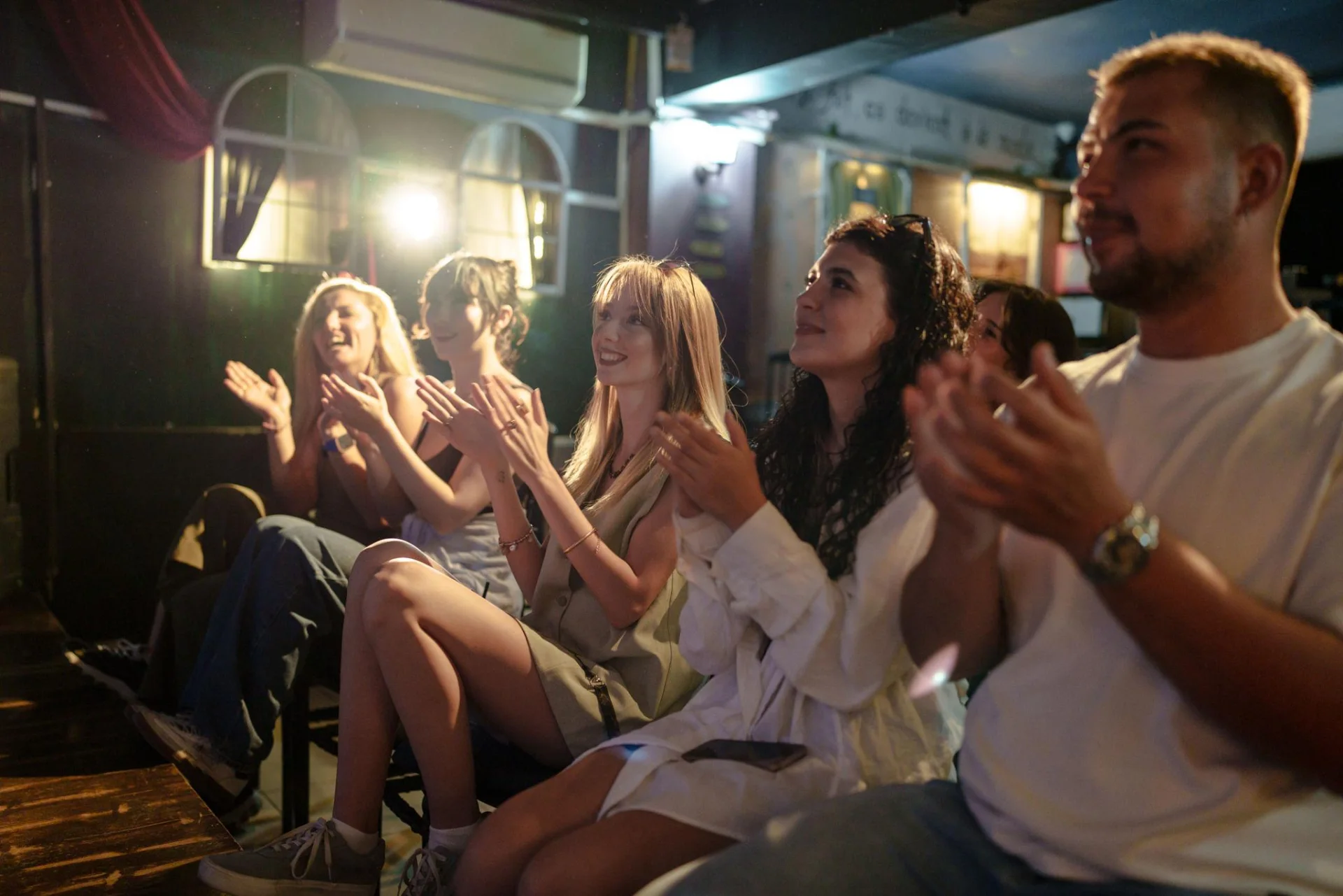
A featured mentalism set after dinner is the one moment when the whole room experiences the same thing at once.
Matching the entertainment to your room
The format that works is largely determined by the space you have booked, and it is worth thinking about before you sign the venue contract rather than after.
Hotel ballroom
Ballrooms are built for volume and sightlines, which makes them well suited to a featured performance after dinner. The trade-off is that a large room can swallow intimacy, so a featured set here needs a microphone and a defined focal point. Roaming magic still works during the reception, but plan for a longer cocktail hour so the performer can reach a meaningful share of the room.
Restaurant private dining room
Private dining rooms are the easiest rooms to perform in and the hardest to schedule around, because the meal service sets the clock. Close-up entertainment between courses works beautifully here. A seated set works too, as long as it is placed after the entrees rather than competing with them. For groups of forty or fewer, this room type consistently produces the strongest reactions.
Your own office
Plenty of companies host the holiday party in their own space, and it is a better setting than it gets credit for. There is no stage, the acoustics are usually poor, and the lighting is fluorescent, all of which rules out most entertainment but rules in close-up magic specifically. It needs no setup, no sound system, and no cleared floor, which is precisely why it is the format that survives an office party.
Holiday party entertainment in Schaumburg
Schaumburg is the corporate center of the northwest suburbs, and its holiday party season reflects that. The Woodfield corridor, the campuses along I-90 and Meacham Road, and the hotel and convention space anchored by the Renaissance Schaumburg give the village a density of mid-size and large employers that few suburbs match.
Parties here tend to be bigger than the western suburb average, frequently 100 to 300 guests, often in a hotel ballroom, and often with a recognition segment built into the agenda. That combination points directly at the hybrid format: roaming close-up magic during a long cocktail hour, then a featured mentalism set that gives a large, mixed room one thing to experience together. The awards integration described above is also a natural fit, because Schaumburg parties are more likely than most to already have a formal segment on the schedule.
The other Schaumburg reality is scale of staff. When a company draws employees from Hoffman Estates, Palatine, Elk Grove Village, and Arlington Heights, the guest list spans a lot of people who genuinely do not know each other. Entertainment that creates crossover conversation is doing real work at a party like that. Full booking details are on the Schaumburg magician and mentalist page.
Holiday party entertainment in Rosemont
Rosemont is a different animal entirely. Two square miles, almost no residents, and one of the densest concentrations of hotel and event space in Illinois. Between the Donald E. Stephens Convention Center, the hotel cluster along River Road, the Parkway Bank Park entertainment district, and the Blue Line stop, Rosemont exists to host events for people who are not from there.
That changes what a holiday party needs. A meaningful share of Rosemont corporate events in December are not neighborhood parties at all: they are year-end meetings, national sales gatherings, and client events where attendees fly into O’Hare, stay two nights, and go home. The room is full of people who work for the same company and have never met.
For those events, the welcome reception opener is the highest-value slot in the entire agenda. Close-up entertainment on the first night, before the formal program begins, breaks a room of strangers into groups that are laughing together within twenty minutes, which changes the tone of every session that follows. Rosemont also hosts plenty of local company parties in its restaurants and hotel spaces, where the standard cocktail hour and after-dinner structure applies. Details for both are on the Rosemont magician and mentalist page.
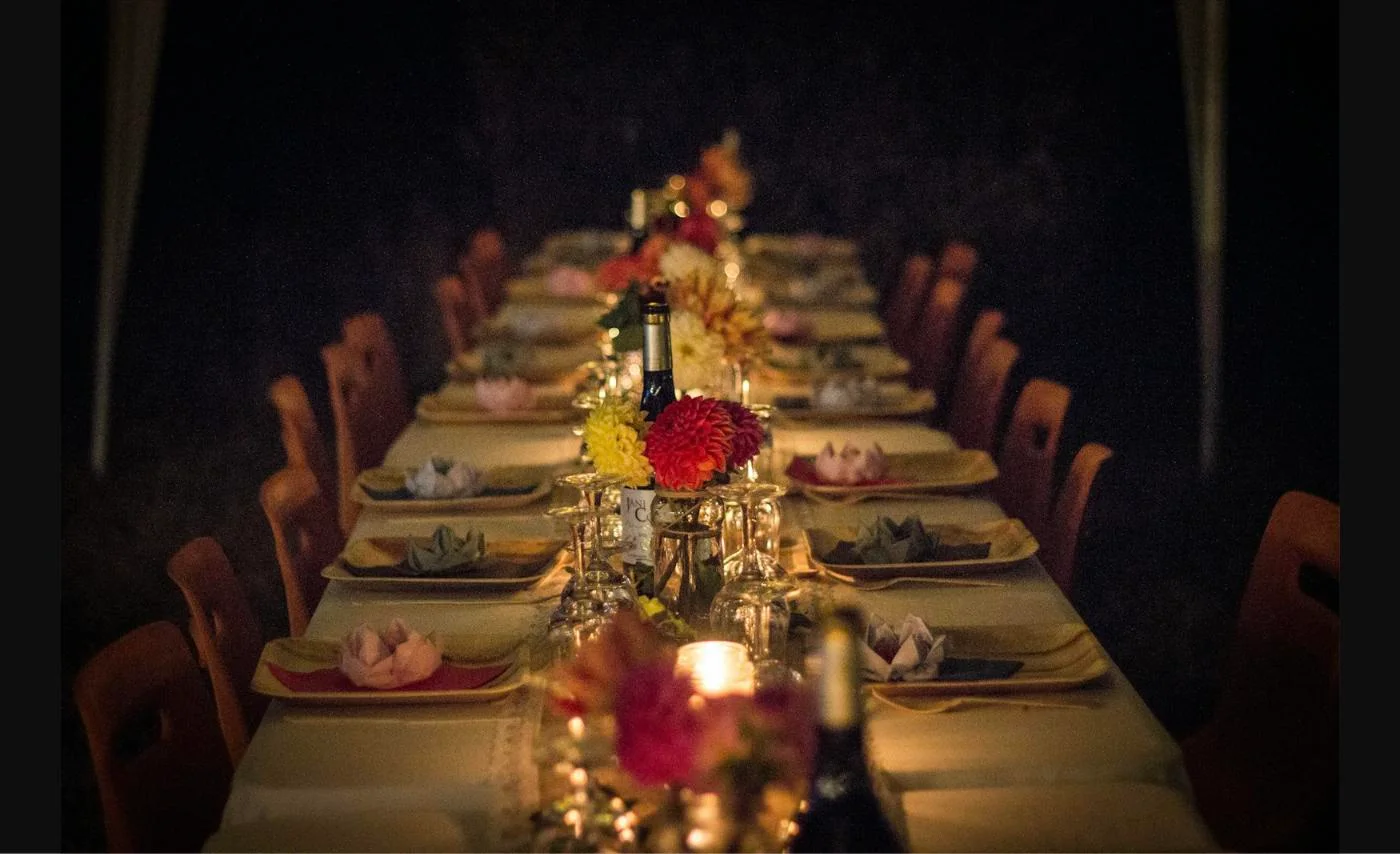
Smaller parties in private dining rooms are where close-up magic hits hardest, because there is no distance to overcome.
Holiday party entertainment in Elmhurst
Elmhurst runs smaller and closer to home. The employer base skews toward professional services, medical and dental practices, law and accounting firms, family-held businesses, and the kind of company where the holiday party is thirty to sixty people who genuinely know one another. The party is often at a restaurant on York Street or Spring Road, or in a private room downtown within walking distance of the Metra station.
Smaller and more familiar changes the calculus in a useful direction. In a room of forty people who have worked together for years, close-up magic performed at arm’s length is more powerful than any staged show, because there is no distance to overcome and no one is anonymous. Mentalism built around specific people in the room, the running jokes and the shared history, is the version of personalization that only works at this scale.
Elmhurst parties also tend to be scheduled on weeknights more often than Schaumburg or Rosemont events, which is worth knowing when you check availability. Booking information is on the Elmhurst magician and mentalist page.
Hosting further west along I-88? See the guide to holiday party entertainment in Naperville, Lisle, Downers Grove and Wheaton. Still deciding whether a mentalist is the right fit for your group? Start with what to expect when you hire a mentalist for your corporate holiday party.
What holiday party entertainment costs
Pricing depends on three things: how long the performance runs, how many guests are in the room, and whether you are booking roaming close-up magic, a featured set, or both. A thirty to forty-five minute roaming set during cocktail hour is the most accessible option and the one most companies start with. A full evening combining roaming and a featured performance sits higher, and December dates carry the demand of the busiest four weeks of the year.
A useful rule when comparing quotes: entertainment is typically a small fraction of what the venue and catering cost for the same evening, and it is the only line item guests will describe to someone else afterward. The 2026 pricing guide breaks down the variables in more detail.
If you have not locked in a date yet
December has four Fridays and four Saturdays, and every company in Cook and DuPage County is competing for the same eight nights. If your date is still open, the company party booking timeline covers how far ahead to move and what your options look like at each stage. If December is already gone, a January kickoff or a February appreciation night buys you a better room, a better rate, and guests who are not attending their fourth party of the month. Companies that make that switch permanently rarely go back, and it is why employee appreciation events outside the holiday season have become such a common alternative.
Frequently asked questions
How long should entertainment run at a company holiday party?
For roaming close-up magic, sixty to ninety minutes covers a typical cocktail hour and lets a performer reach most of the room. A featured mentalism set after dinner usually runs twenty-five to forty minutes, which is long enough to build and short enough to end while the room still wants more.
Will this work with a group that has been drinking?
Yes, and it is worth choosing the format with that in mind. Roaming close-up magic early in the evening works with any crowd. A featured set lands best before the bar has been open for four hours, which is a practical argument for placing it right after dinner rather than late in the night.
Does this work for 200 people, or only small groups?
Both, with different formats. Large rooms need a featured performance with a microphone and a clear focal point to create a shared moment, and roaming magic during a longer reception to cover the room. Small rooms need almost nothing but proximity.
Do we need a stage or sound system?
Roaming close-up magic needs neither. A featured set in a room of more than about sixty guests needs a microphone and a small clear area to work in, but not a riser or a stage. This is one reason entertainment of this kind is easier to add late in the planning process than most other vendors.
Is mentalism appropriate for a work event with clients in the room?
It is one of the better choices for exactly that situation. Mentalism does not require volunteers to do anything embarrassing, which is the risk most planners are quietly worried about when clients or executives are present. The performance treats participants as intelligent and lets them look good, which is the outcome you want when the room includes people you are trying to impress.
How late can we still book a December date?
Weekday dates and early December are frequently available inside of six weeks. December Fridays and Saturdays are usually committed well before then. If your date is fixed and it falls on a December weekend, lead with the date and guest count on the first call so nobody spends time on options that are already gone.
Give them something to talk about in January
A good venue and a good meal will produce a pleasant evening. What makes a company holiday party memorable is a moment nobody at the table saw coming, shared by the whole room at once. For companies in Schaumburg, Rosemont, Elmhurst, and across Chicagoland, close-up magic and mentalism turn a scheduled obligation into the night people bring up at work three weeks later.
With 25 years of performing for corporate audiences across the Chicago area, Nick Gasparro builds holiday party entertainment around your room, your agenda, and your guests. Check availability for your date, or see the work in person at one of the upcoming live shows.